The role of animals in ocean nutrient cycling
Seafloor sediment mixing by burrowing animals (bioturbation) can greatly impact nutrient cycling and energy flow through marine ecosystems. I’m interested in how marine sedimentary rocks and the fossils they contain may provide evidence for these interactions in Earth’s past, especially across mass extinctions that may serve as deep-time analogs for future ocean warming.
In a case study across the end-Permian mass extinction (Beaty et al., 2025 Geobiology), I investigated bioturbation-geochemical relationships within marine sedimentary rocks exposed in Svalbard, Arctic Norway. I found that shifting patterns of bioturbation had a significant effect on carbon, sulfur, and phosphorus burial across this ancient seafloor setting, illustrating how benthic ecosystem collapse can influence ocean chemistry in the wake of mass extinctions.
Currently I am using Earth system models to investigate whether the response of bioturbators to ocean warming can impact marine biogeochemical cycling at a global scale, and potentially act as a feedback on near-future climate change.
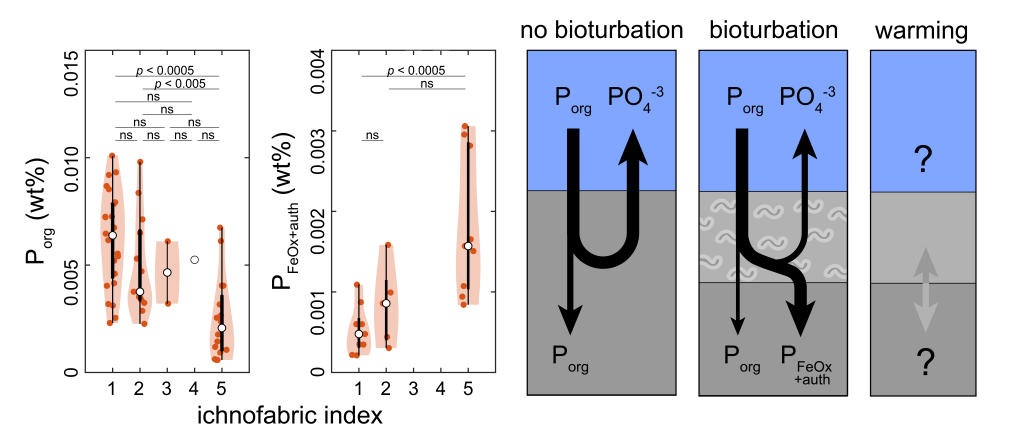
Bioturbation effects on phosphorus cycling in sediment. Geochemical data from Beaty et al. (2025) Geobiology
Weathering and the global carbon cycle
The chemical breakdown of rocks at Earth’s surface is the main sink for atmospheric CO2 on geologic timescales, as well as source for nutrients to the biosphere. During my PhD I was particularly interested in the nature of weathering on land prior to the origin of plants—a time when the continents are traditionally envisioned as barren and lifeless. Much of my work involved geochemical analyses of paleosols, or fossil soils, which provide snapshots of the weathering zone across Earth history.
Using insights from modern soils, I proposed that aluminum-titanium decoupling in paleosols may serve as evidence for organic acid weathering as far back as 3 billion years ago (Beaty and Planavsky, 2021 Geology), implying the presence of microbial life on land long before plants. I then explored the potential productivity of an entirely microbial terrestrial biosphere (Planavsky et al., 2021 Nature Reviews Earth & Environment).
More recently I’ve worked on stable isotope fractionation within the weathering zone, focusing particularly on lithium isotopes, which can record information about the efficiency of CO2 drawdown from weathering. My ongoing work investigates how these signals are generated in the weathering zone and ultimately preserved in geologic archives. The goal is to better understand weathering’s role in climate regulation over Earth history, along with the potential for enhanced weathering (a proposed carbon capture strategy) to remove CO2 on a global scale in the coming decades.
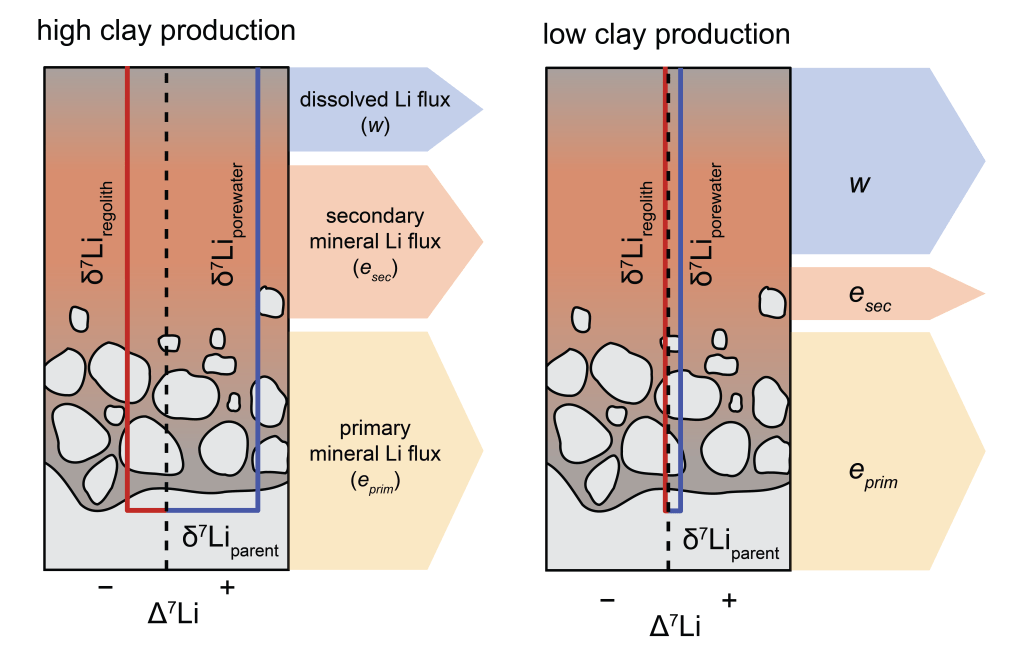
Schematic of lithium isotope fractionation in soils (Beaty et al., in prep)

 Brian Beaty